A Measure of Abundance
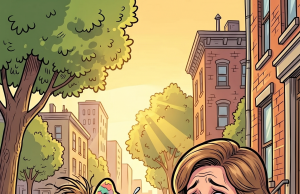
For nearly a month, Daniel Hartman mapped out the exact same daily route through Riverside Commons—a modest, unpretentious park framed by weathered brick apartment blocks and a sluggish Portland waterfront.
He constantly assured himself that these long excursions were merely for a breath of fresh air. The underlying reality, however, was far more painful to articulate.
Three weeks prior, his father had passed away—suddenly, quietly—leaving behind an immense real estate empire that Daniel had technically inherited years ago but had never truly internalised. At forty-one, Daniel held the deeds to boutique hotels, bustling commercial centers, and a net worth far greater than he could ever exhaust. Yet, ever since the casket was lowered, his sprawling penthouse had felt suffocating. Entirely too vast. Too silent. Too vacant.
His father’s parting advice echoed persistently through his thoughts—a stubborn memory that surfaced whenever the silence grew too loud.
“If you ever find yourself losing your anchor,” his father would remind him, “walk among the people who are actually living. Wealth alone teaches you absolutely nothing about the human condition.”
And so, Daniel kept walking.
On that particular late autumn afternoon, the park was awash in rich shades of rust and amber. Brittle leaves fractured beneath his leather shoes. A nearby food vendor hissed with steam, casting the rich scent of grilled onions into the crisp, biting air. The distant laughter of children drifted from beyond the tree line. The world kept spinning.
Daniel decelerated his pace as he approached a weathered wooden bench nestled beneath a grand maple—and that was when they caught his eye.
A young mother sat bent forward, precariously balancing a clear plastic takeout container on her knees. Two young children were pinned tightly against her sides. Their winter coats were thin and clearly secondhand, yet immaculately clean. Their shoes were scuffed at the toes, and their faces bore a heavy, hollow exhaustion that no child should ever have to carry.
The woman carefully unclasped the lid of the container.
Inside was a meager portion of white rice, black beans, and a single link of smoked sausage—meticulously sliced into tiny segments.
Daniel stopped dead in his tracks before he could even question his own intrusion.
With measured, deliberate movements, the mother began dividing the food onto two paper plates. She moved the vast majority of the nourishment over to her children’s portions.
What remained in the central container was scarcely enough for more than two small bites.
She handed the plates down to them first.
A sudden tightness constricted Daniel’s chest.
The scene lacked any theatrical drama. There was no desperate begging, no tears, no grand display. It was simply a quiet, routine sacrifice—the kind that demanded absolutely no audience to be profoundly devastating.
The boy, who looked to be around nine, began eating with a ravenous speed. The little girl—perhaps five—took tiny, agonizingly careful bites, as if trying to trick her mind into making the meal endure. The mother lifted her plastic plastic fork, hesitated for a long second, and then quietly lowered it back down. Her hand was trembling with a faint, involuntary shudder.
Daniel felt a barrier break open within his own heart.
He had dined alone in Michelin-starred establishments more times than he could count. He had personally discarded more food at the end of a business dinner than what currently occupied that plastic container.
The woman suddenly swayed slightly, pressing two fingers firmly against her temple to stave off a wave of dizziness. The boy picked up on the movement instantly, leaning his small shoulder heavier against her side.
She quickly offered him a bright, reassuring smile—a shield constructed entirely out of maternal love to keep him from worrying.
That was the precise threshold Daniel could not bring himself to pass by.
Shared Bread
He stepped forward with slow, unhurried strides, intentionally projecting an unassuming presence. He didn’t approach as a grand benefactor or a wealthy savior. He approached simply as one human being acknowledging another.
The children noticed his shadow first. The boy instantly squared his shoulders, shifting his posture into a protective stance. The little girl just stared up with wide, unblinking curiosity.
The mother looked up last, her eyes defensive.
“Can I help you, sir?” she asked, her tone guarded but unfailingly polite.
“I am incredibly sorry to disturb you,” Daniel said softly, keeping his hands visible. “I truly don’t mean to intrude on your afternoon. I just wanted to ask if you are feeling alright.”
She offered a rapid, reflexive nod. “I’m perfectly fine. Just a long day.”
The boy creaked his brow, looking up at Daniel. “My mom hasn’t eaten a single thing today.”
“Evan,” she interjected, her voice sharp with a mother’s pride.
Daniel raised his hands slightly, dropping his pitch. “It’s completely okay.”
A heavy silence settled over the bench.
“My name is Daniel,” he offered gently. “I take a lap through this park every afternoon. Would it be alright if I occupied the other side of this bench for just a moment?”
She scanned his face, hesitated, then gave a slight nod. “I’m María. This is Evan—and my youngest, Sophie.”
Sophie offered a shy, gap-toothed grin, and Daniel returned it.
“I have no desire to make you feel uncomfortable,” Daniel said, selecting his words with immense care. “But I was genuinely wondering if you would allow me to escort you all across the street to buy a proper, hot meal. There are absolutely no conditions attached. Just good food.”
María’s spine instantly went rigid. “We aren’t out here soliciting charity, Mr. Daniel.”
“I am well aware of that,” Daniel replied softly. “And honestly, that is the exact reason I am offering.”
She scrutinized his features, searching for the sting of pity, or worse, the coldness of judgment. Discovering nothing but a quiet sincerity in his gaze, she looked down at the paper plates resting on her children’s laps.
“I lost my father very recently,” Daniel continued, his voice dropping an octave. “He lived by the philosophy that no soul should have to weather a storm alone when shelter is freely extended. Today… I am simply trying to honor his memory.”
María’s eyes shimmered with a sudden glaze of tears. She swallowed heavily, her pride battling her exhaustion.
“Just a single meal,” she conceded quietly. “Nothing more.”
Daniel offered a respectful nod. “You have my word.”
They walked together to a modest, neon-lit diner directly across the avenue—a place defined by duct-taped vinyl booths, steam-fogged windows, and the rich, comforting aroma of roasted meats and fresh bread.
Evan devoured his burger as if he hadn’t seen protein in days. Sophie dipped her crusts into a bowl of tomato soup, savoring every drop. As the warm food took effect, a healthy flush of color slowly returned to María’s cheeks, and her shoulders finally lost their rigid tension.
“What line of work are you in, Daniel?” she inquired over her tea.
“I oversee some commercial real estate in the city,” he answered simply.
She nodded in understanding. “I used to work as a head baker. Late-night shifts, early morning bakes. It was a beautiful life. But when the facility went bankrupt and shuttered its doors, the dominoes just started falling one by one.”
“She bakes the greatest sourdough in the entire state,” Evan chimed in proudly, his mouth half-full.
Daniel felt a sudden, profound clarity click into place inside his mind.
A New Enterprise
Fourteen days later, María stood entirely frozen on the pavement, staring through the spotless plate-glass window of a newly renovated storefront on the edge of Riverside Commons.
“You explicitly told me this was a formal employment interview,” she whispered, her voice trembling.
“It is,” Daniel replied, pulling a gleaming set of brass keys from his pocket and slotting them into the lock.
He pushed the door open, revealing an expansive, state-of-the-art culinary space. Industrial ovens gleamed under the track lighting, marble countertops stretched along the walls, and wooden display racks stood ready to be populated.
Gold lettering freshly painted onto the glass facade spelled out: The Second Rise Bakery.
“I acquired this commercial asset late last year,” Daniel explained, stepping inside the fragrant room. “I was simply waiting for the right creative vision to justify opening the doors.”
María shook her head, her hands flying to her mouth as she overwhelmed by the gesture. “Daniel, I cannot possibly accept this from you—”
“You aren’t accepting a handout,” he interrupted firmly but gently. “You are going to operate the entire enterprise. You will handle the inventory, manage the staff, and earn every single dollar that passes through that register. I am merely providing the initial structural foundation. In exchange for the lease, I only ask for one specific condition.”
She looked at him through her tears. “What is it?”
“Prioritise hiring the people in this neighborhood who desperately need a second chance at life.”
The tears spilled over, tracing clean lines through the light dust of flour on her face.
The bakery officially launched its operations on a biting, frost-covered January morning.
Long before the sun could clear the horizon, a substantial line of neighborhood residents had already snaked down the block. The intoxicating, rich aroma of warm yeast and toasted grains blanketed the cold pathways of Riverside Commons.
Inside, Evan was proudly organizing stacks of napkins at the counter. Sophie stood by the glass, waving enthusiastically at every customer who walked through the door. María commanded the kitchen behind the counter, a stray smudge of flour accenting her cheek as her vibrant laughter echoed over the chime of the entrance bell.
Daniel stood on the opposite side of the avenue, leaning against a lamp post, quietly taking in the scene.
For the absolute first time since his father’s funeral, the suffocating, heavy compression inside his chest dissolved entirely. He felt the warmth of the morning sun.
He finally comprehended his father’s final lesson.
True prosperity was never measured by the assets tied to your name. It was defined entirely by what you possessed the courage to notice.
And occasionally, the entire trajectory of a human life shifts—simply because one person refused to look away from a mother dividing her final meal.