The silver drizzle of an October evening descended upon Seattle in thin, shimmering lines, coating the pavement in a slick, obsidian sheen that reflected the neon glow of the city. On the corner of Pike Street, tucked between the towering glass monoliths of the financial district, stood a weathered food cart adorned with a fading striped awning. Most pedestrians, huddled beneath their umbrellas and fixated on the blue glow of their phones, hurried past without a second glance, treating the cart and its occupant as a mere fixture of the urban landscape.
Eleanor Vance stood behind the narrow metal counter, wiping the condensation from the glass and periodically massaging her swollen wrists. At sixty-four, the damp cold of the Pacific Northwest seemed to have taken up permanent residence in her joints, and the twelve-hour shifts on her feet were becoming a grueling test of endurance. But the city’s rising property taxes and the mounting stack of utility bills at home were indifferent to her exhaustion.
“Warm pretzels! Get your fresh hot dogs here!” she called out, though her voice lacked its usual resonance.
The frantic pace of the lunch hour had long since dissolved into the sluggish rhythm of the evening. Long shadows stretched between the buildings, and the city hummed with that specific brand of metropolitan apathy where millions of people live in close proximity yet remain entirely untouchable to one another.
It was in this gray, lonesome twilight that she first noticed the child.
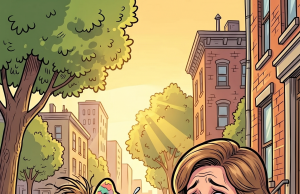
The girl was standing near the edge of the crosswalk, dwarfed by an oversized, charcoal-colored hoodie that was frayed at the cuffs and stained with the city’s grit. Her blonde hair was a tangled mess, matted against her forehead by the mist. She couldn’t have been more than six or seven years old. Her small, pale hands were tucked deep into her sleeves as she stared at the food cart with a look of such profound, quiet desperation that Eleanor felt a physical pang in her chest.
Eleanor had encountered the hungry before—thousands of them over the decades. She had seen the aggressive beggars, the slick grifters, and the broken-spirited. But this child was different. She wasn’t holding out a hand; she wasn’t weaving through the crowd. She simply stood there, trembling in the cold, her lower lip tucked between her teeth as she fought back the urge to cry.
Eleanor leaned over the counter, her voice softening into a maternal hush. “Hey there, little one. Are you looking for something to eat?”
The girl blinked, startled as if she had been invisible for so long that being spoken to was a shock. She quickly wiped her damp face with a sleeve and offered a single, hesitant nod.
Eleanor glanced toward the sidewalk, searching for a distracted parent or a frantic guardian, but the crowd moved on, oblivious. “Where is your mom, honey?”
“She’s at her cleaning job,” the girl whispered, her voice barely audible over the hiss of passing tires.
“And your dad?”
The child lowered her gaze to her scuffed sneakers. “Don’t have one of those.”
The air felt suddenly colder to Eleanor. “What’s your name, sweetheart?”
“Clara.”
“Well, Clara,” Eleanor said, reaching for a fresh bun with a practiced grace, “why don’t you come closer to the heater? Let’s get you something warm.”
The girl hesitated, her eyes darting around as if she expected a reprimand from the shadows. Eleanor carefully prepared a hot dog, wrapping it in a foil sleeve to trap the heat, and held it out.
Clara stared at it as if it were a holy relic, but she didn’t reach for it. “I… I don’t have any money to give you,” she stammered, her voice thick with shame.
“I’m not asking for money,” Eleanor replied.
“No,” Clara said, shaking her head with a stubbornness that was far too old for her face. “My mama says you can’t just take things. She says kindness is a debt you have to settle.”
Eleanor felt a faint, sad smile touch her lips. “Is that so? Well then, Clara, you can just pay me back later. Somewhere down the road.”
The girl’s watery blue eyes lifted, searching Eleanor’s face for a lie. “You mean it? Truly?”
“Cross my heart.”
Clara accepted the foil-wrapped treasure with both hands, cradling it against her chest for its warmth before she finally took a bite. As she chewed, tears began to track through the dirt on her cheeks—not the loud, dramatic sobs of a frustrated child, but the quiet, rhythmic weeping of a person who had been tired and hungry for a very, very long time.
Eleanor felt a stinging behind her own eyelids and had to turn away under the guise of organizing her mustard dispensers. “When was the last time you had a real meal, Clara?”
The girl shrugged, her focus entirely on the food. “I gave my lunch crackers to Mama yesterday because she said her stomach felt like it was shrinking.”
Without a word of ceremony, Eleanor began packing a larger paper bag. She added a second hot dog, two soft pretzels, a carton of apple juice, and a bottle of water. She slid it across the metal counter.
Clara’s eyes widened until they looked like saucers. “Oh, no, that’s far too much.”
“It’s exactly the right amount,” Eleanor countered firmly.
The child clutched the warm bag to her hoodie, the steam rising around her face. She looked up at Eleanor with a solemnity that felt like a vow. “I’m going to remember this. One day, I’ll come back for you. A big, shiny black car is going to stop right here on this corner.”
Eleanor let out a soft, genuine laugh that echoed against the metal walls of her cart. “A shiny black car, you say?”
Clara nodded with absolute conviction. “And I’ll bring you something very important to pay you back for the kindness.”
“Well,” Eleanor said playfully, leaning on her elbows, “I suppose I’d better stay right here on this corner so you can find me.”
The little girl offered her first real smile—a flash of light in the gray evening. Then, she turned and disappeared into the misty throng of the city.
Eleanor never saw her again.
The Unforgiving Rhythm of the Years
Life in the city moved with its characteristic, relentless momentum—fast, noisy, and largely indifferent to the passage of time. The years blurred into a cycle of biting winters that froze Eleanor’s fingers to the tongs and sweltering summers that turned the cart into a literal oven. She remained a sentinel on her corner, watching the skyline change and the old brick buildings get swallowed by glass towers, while she remained the same.
A few customers became familiar faces—the evening shift nurse who liked extra onions, the weary law clerk who never said a word—but most were ghosts, forgotten the moment their napkins hit the trash. And yet, on those long, solitary nights when she scrubbed the grease from the grill, Eleanor would find her mind wandering back to the little girl in the oversized hoodie.
“One day, I’ll pay you back.”
The memory became a small, secret warmth she kept tucked away, a reminder that in a city of millions, she had once mattered to one small soul.
However, the final year of Eleanor’s career proved to be a crucible. The costs of living in the city had skyrocketed, and her landlord had tripled the rent on her studio apartment. A sudden hip surgery had depleted her meager savings, leaving her with a mountain of medical debt that felt insurmountable. To make matters worse, the city council had passed new zoning regulations designed to “beautify” the district, which involved revoking the permits of older street vendors to make room for high-end kiosks.
Eleanor fought the bureaucracy as long as she could, but by the time the leaves began to turn brown in the parks, she was drowning.
One frigid Thursday evening, she sat on her small stool inside the cart, the light of a single bulb illuminating a stack of final eviction notices and permit denials. For the first time in forty years, the weight of the city broke her.
“I just can’t carry it anymore,” she whispered to the empty air, her voice cracking.
She sat there, letting the silent tears of exhaustion fall, while the evening traffic crawled past the curb. Thousands of people hurried toward their warm homes, oblivious to the old woman weeping behind the fogged glass of a hot dog stand.
Then, a sleek, midnight-black sedan pulled up silently beside the sidewalk.
Eleanor didn’t even look up at first, assuming it was just another executive waiting for his driver. But the car stayed idling, its polished surface reflecting the city lights. A man in a dark suit stepped out from the driver’s seat and opened the rear door with a formal precision.
A young woman emerged from the vehicle.
She was tall and carried herself with an effortless, quiet elegance. She wore a tailored cream-colored trench coat, and her blonde hair was swept back into a sophisticated knot. Despite the expensive attire and the aura of success that surrounded her, there was something in her features that caused the air in Eleanor’s lungs to catch.
The woman walked slowly toward the cart, her heels clicking rhythmically on the pavement.
Eleanor straightened her apron, her hands trembling as she wiped her eyes. “I’m sorry, dear, but I’m afraid I’m closing up for good.”
The young woman stopped at the counter, a gentle, knowing smile playing on her lips. “I know you are.”
The voice hit Eleanor like a physical shock. It stirred a dormant memory, a echo from a rainy night fourteen years earlier. Eleanor studied the woman’s face, tracing the line of her jaw and the curve of her brow until she saw them—those wide, piercingly blue eyes.
Eleanor’s breath hitched. “…Clara?”
The young woman’s eyes immediately filled with tears, and she nodded. “I told you I’d find you, Eleanor.”
Before Eleanor could process the impossibility of the moment, Clara had stepped around the counter and wrapped her in a fierce, crushing embrace. Eleanor froze for a second before burying her face in the girl’s shoulder, sobbing with a relief she hadn’t known was possible.
“You actually came back,” Eleanor whispered into the silk of the woman’s coat.
“I promised I would, didn’t I?”
The Architecture of a Settled Debt
For a long moment, the roar of the city seemed to vanish, leaving only the two of them in the dim light of the awning. Finally, Eleanor pulled back, dabbing at her eyes with a paper napkin. “Look at you. You’re a grown woman. You look like a movie star.”
Clara laughed softly, though her voice was still thick with emotion. “And you still look exactly like the woman who saved my life on a Tuesday night.”
“What in the world are you doing in that fancy car? And where have you been all these years?” Eleanor asked, her bewilderment finally taking over.
Clara glanced back at the sedan. “That car belongs to me, Eleanor. I’ve spent the last three years searching for you. I moved back to the city specifically to settle my accounts.”
“You searched for me?”
“I never had a choice,” Clara said, her expression turning serious. “That night… the food you gave me didn’t just fill my stomach. It fed my mother and me for two days. It gave us enough strength to make it to a shelter that finally helped my mom get into a nursing certification program.”
Eleanor listened, rapt, as Clara explained how her mother had eventually graduated at the top of her class, slowly pulling them out of the cycle of poverty. “I watched how hard she worked,” Clara continued, “and I realized that the only way to pay back the world for people like you was to be better than everyone else. I earned scholarships, I worked three jobs in college, and eventually, I started a small software firm that took off faster than I ever dreamed it would.”
There was no pride in Clara’s voice, only a profound sense of gratitude. “I became successful, Eleanor. Very successful. But every time I sat in a boardroom or looked at my bank balance, I remembered the taste of that hot dog in the rain and the woman who told me I could pay her back later.”
Clara reached into her designer handbag and pulled out a sleek, embossed folder, placing it gently on the metal counter. “I believe ‘later’ has finally arrived.”
Eleanor frowned, adjusting her reading glasses. “Now, Clara, I told you back then you didn’t owe me anything.”
“And I told you I’d settle the debt,” Clara replied softly. “Please. Open it.”
Eleanor opened the folder. Inside was a property deed, fully executed and cleared of all liens. She blinked, her mind struggling to make sense of the legal jargon. Clara pointed across the street to a beautiful, newly renovated corner storefront with large bay windows and a brand-new brick facade.
“I bought the building yesterday,” Clara said.
Eleanor’s hands began to shake uncontrollably. “Clara… no. This is far too much. I can’t possibly take a building.”
“It isn’t just a building,” Clara said, leaning in. “You’ve spent forty years standing in the rain and the snow to take care of this neighborhood. I thought it was about time the neighborhood took care of you. It’s a fully equipped commercial kitchen and a dining room.”
Eleanor looked down at the deed again. At the very top, the name of the new business was already printed in elegant gold leaf: Eleanor’s Hearth.
“I remembered how you used to call everyone sweetheart,” Clara said with a watery smile. “I figured the city could use a place that actually felt like someone’s home.”
Eleanor collapsed into a chair, the deep, uncontrollable sobs finally breaking through the decades of stoicism. For fourteen years, she had carried the weight of her invisibility. She had been a ghost on a street corner, a servant to a city that didn’t know her name. And suddenly, she was seen.
Clara walked over and held her again. “You gave me a hot dog that night, Eleanor. But what you really gave me was the realization that I was worth being helped. You gave me back my dignity.”
The traffic lights changed from red to green, and the horns echoed in the distance as Seattle continued its frantic, indifferent dance. But on that one small corner, the air felt warm and still.
Before she left, Clara reached into her car and brought back one final gift. It was a small, silver-framed photograph. Eleanor looked down and saw a grainy image captured by a nearby security camera fourteen years ago. It showed a tired, older woman leaning out of a cart window, smiling with genuine kindness at a tiny, bedraggled girl who was holding a hot dog with both hands.
At the bottom of the frame, seven simple words were engraved:
“One act of kindness can change the world.”
Eleanor pressed the frame to her heart, looking out at her new restaurant across the street. For the first time in her life, the silver drizzle of the rain didn’t feel cold at all. It felt like a blessing.