The Architecture of an Unseen Sanctuary
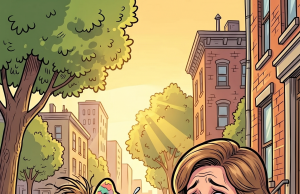
The silver precipitation had been falling over the valley of San Tomas for forty-eight consecutive hours, a thin, unrelenting drizzle that transformed the historic avenues into long, shimmering ribbons of gray water. Most pedestrians moved through the downpour with a frantic, mechanical urgency, their heads lowered beneath black umbrellas as they hurried toward the promise of heated entryways and dry footwear. They navigated the weather with an absolute, unblinking focus on their own destinations, entirely cocooned within the urgent parameters of their individual schedules.
But the child standing near the perimeter of the public garden possessed no structural point toward which she could accelerate her pace.
At seven years old, her frame was a slight, delicate geometry that seemed far too fragile for the sudden dropping of the October temperature. She was clad in a cotton dress whose fibers had been laundered until they were translucent, offering a porous and entirely futile barrier against the wind that swept off the bay. The soles of her canvas sneakers had fractured so severely along the rubber seams that the freezing moisture of the pavement soaked through to her skin with every movement of her heels. Despite the elements, she remained anchored to the concrete, extending a small, wilting cluster of wild marigolds toward the passing crowd—blooms she had meticulously harvested from the untended borders of the municipal grounds earlier that morning.
“If you could spare a single quarter, sir, it would be an immense assistance,” she murmured, her voice a low, bird-like vibration that was consistently swallowed by the ambient hum of the passing delivery trucks.
The majority of the populace conducted their movements as if she were merely a structural detail of the urban landscape, an invisible fixture woven from the fabric of the rain itself. In San Tomas, the residents had developed a clinical familiarity with children who drifted through the peripheral spaces of the commerce district—small, nomadic figures who appeared to belong to no specific register.
She had previously occupied a space in an institutional youth home on the north side of the tracks, but the facility had never manifested the actual properties of a sanctuary. There were far too many dependencies balancing against a depleted budget, the daily bread was rationed with a mathematical severity, and there were far too few adults who possessed the emotional capacity to notice when a child spent the midnight hours weeping into the rough wool of a dormitory blanket. Eventually, the girl had simply slipped through the unlocked gate during a shift change, and the machinery of the institution had never generated a search party to retrieve her name from the streets.
The Basket on the Granite Ledger
By late afternoon, the atmospheric pressure seemed to drop even further, turning the yellow halogen lamps of the avenue into hazy, floating halos against the encroaching gloom. The downpour had created deep, dark pools across the brick paths of the park, transforming the grass into a patchwork of black mud.
The child was preparing to retreat toward her evening shelter when her focus was arrested by an object that didn’t conform to the general debris of the lot. Positioned between two vast puddles, resting flat against the granite ledger of an empty bench, sat a sturdy wicker basket.
It possessed a striking, unnatural cleanliness against the wet masonry. It had been deposited with a deliberate, calculated precision that suggested an intention to shield it from the worst of the wind.
Almost… an architecture of protection.
Her brow furrowed into a defensive line because, in the harsh logic of the streets, anything that appeared exceptionally valuable or carefully arranged usually signified an underlying trap. Still, a primitive, uncalculated curiosity pulled her leather soles across the wet gravel until she stood directly within its orbit. The wicker frame was covered by a thick, cream-colored wool blanket—a textile far softer and more substantial than any object she had ever been permitted to call her own.
For a handful of seconds, she hesitated, her hands tucked behind her back as she checked the empty treeline for witnesses. Then, with a slow, trembling movement of her fingers, she peeled back the border of the wool.
The breath left her lungs all at once, leaving her mouth open in a silent, frozen gasp.
Cradled within the interior were three infants, their features an absolute, identical replication of one another. They were triplets, likely no more than a few months into their development, wrapped inside intricate linen garments that bore the unmistakable quality of high-end tailoring—clothing far too affluent for the forgotten corners of San Tomas. Their small cheeks carried a healthy, porcelain pinkness, and their skin possessed a delicate, unblemished softness.
And then there were their eyes.
The Silence of the Three
All three infants had opened their lids simultaneously, revealing three pairs of large, liquid eyes of an impossible, deep twilight blue. They were not screaming with the frantic, high-register energy that usually accompanies a child’s physical distress; instead, they were producing small, rhythmic, and exhausted sounds, a sequence of quiet whimpers that suggested they had already adapted to a heartbreaking reality.
They had already learned that the silence of the park was absolute, and that no one was returning to check the latch.
The tiny, fragile frequency of their breathing pierced through the protective armor she had spent a year constructing behind her ribs. She recognized the exact dimensions of that silence; it was the identical, suffocating vacuum she had navigated on the Tuesday night she finally realized her own mother’s name had been permanently removed from the shelter registry. For a long interval, she simply stared into the basket, her own heartbeat performing an uncoordinated drumming against her chest.
Then, the infant positioned on the left extended a tiny, unblemished hand from beneath the linen, his small fingers tracking a random pattern in the air until they brushed against the cuff of her wet sleeve.
The knot in her throat tightened until it was painful to swallow. “I am not going to allow the frost to claim your timeline,” she whispered, the syllables vibrating with a seriousness that far exceeded her seven years.
She cast a final, investigative glance across the perimeter of the grounds, but the persistence of the downpour had long since driven the last security guards and vendors into the warm interiors of the downtown shops. There was no logic to explain why three heirs to an obvious fortune had been abandoned on a wooden bench in the middle of a storm, but the mathematics of the evening were simple: if she left the basket where it sat, the plummeting temperature of the night would ensure their machinery stopped before the morning light reached the avenue.
The Weight of the Freight
She took a slow, stabilizing breath, gripped the heavy braided wicker handle with both of his palms, and lifted the structure from the stone ledger. The physical mass of the wood and the linen immediately caused her shoulders to strain, her small muscles trembling under an unexpected gravity.
“You possess far more weight than your faces would suggest,” she murmured into the folds of the cream blanket, her boots sliding precariously on the slick brick path as she anchored the basket against her hip.
Step by agonizing step, navigating the cracked sidewalks and avoiding the deepest pooling of the storm runoff, she guided her cargo out of the park’s boundary. Her destination was the single geographic coordinate she could claim in the entire municipality—an abandoned maritime warehouse situated near the industrial docks at the eastern edge of the city.
The structure could not be categorized as a home by any conventional definition. It consisted of four listing concrete walls, a sequence of shattered window frames that allowed the sea wind to whistle through the rafters, and a corrugated tin roof that leaked systematically whenever the moisture from the bay became too dense. But it provided a physical barrier against the direct trajectory of the storm, and for the duration of this night, the shelter would have to suffice for the four of them.
By the time her shoes cleared the rusted track of the warehouse’s sliding door, her arms felt as though the ligaments had been stretched to their absolute limits. She pushed the heavy iron panel shut with the leverage of her shoulder, the metallic echo of the latch reverberating through the vast, empty interior like a closing vault.
The internal atmosphere smelled of old pine resin, river silt, and the heavy dust of neglected machinery. A collection of weathered shipping crates sat stacked against the western wall, an arrangement she had laboriously pushed together weeks ago to create a sleeping platform that was elevated above the dampness of the concrete floor. She lowered the wicker basket onto the wood with an extreme, trembling care.
The sudden cessation of movement caused the infants to stir within their linen nests. The child in the center began to emit a sharp, rhythmic whimper that threatened to escalate into a full-scale distress call.
“Please, you need to maintain your quiet,” she said hurriedly, her hands hovering over the blanket in a state of total behavioral confusion. She had never been permitted to interact with an infant during her time in the institutional home, but a primitive, maternal intelligence seemed to surge through her blood to fill the gap.
She unknotted the long, wool-blend scarf from her own neck—the single piece of winter apparel she possessed that didn’t have a tear in the fabric—and carefully tucked it around the perimeter of their small bodies, creating a secondary wall of insulation. “There now. The wind cannot reach your skin in this corner.”
The crying subsided into a series of soft, satisfied gurgles, and she let out a long, ragged exhale of her own. But the resolution of their comfort immediately brought forward the next calculation—one she had deliberately avoided during the trek from the park.
The Ledger of the Bakery Trash
Infants required milk to sustain their development, and her own inventory of provisions consisted of absolutely nothing. Her core contracted with a sudden, burning pang of an anxiety that was far more intense than her own hunger. She surveyed the dark corners of the warehouse, her eyes searching the floorboards as if a solution might materialize from the dust, but there was nothing but rusted bolts and old shipping labels.
Then, the internal map of her survival routines highlighted a coordinate two streets away—a twenty-four-hour commercial bakery whose ovens ran on a strict industrial schedule. Every evening at eight o’clock, the kitchen staff cleared the displays, depositing the unsold, day-old loaves into the large bins behind the loading dock.
“I am required to step outside for a brief interval,” she told the basket, her voice dropping into a comforting, conversational rhythm. “Ensure you remain exactly where you are until I return to the room.”
She slipped back out into the silver downpour, her bare ankles completely indifferent to the freezing runoff as she sprinted across the cobblestones of the dock district. When she reached the rear alley of the bakery, the industrial lights were dimmed, but the heavy plastic bins were stationed on the pavement. Her heart hammered against her ribs as she hoisted herself onto the rim, lifting the lid with a frantic, uncoordinated strength.
Inside, resting on top of the clean parchment liners, were several loaves of unflavored sourdough—hardened by the evening air, but entirely free of mold. She secured them against her chest and retraced her steps through the dark lanes.
The Squeezing of the Stone
The infants were awake when she broke through the warehouse door, the smallest of the trine having already initiated a low-frequency cry that indicated her time had run out.
“I am back inside, my loves,” she said gently, dropping the loaves onto a crate and retrieving a dented aluminum cup she had positioned beneath a leak in the roof.
She broke off a small piece of the crust, soaking it in the rainwater until the starch began to dissolve into a thick, milky paste. It was a primitive substitute for actual infant formula, a solution that would have horrified a medical professional, but the logic of the street offered no alternative. She used her fingers to carefully compress the softened bread, squeezing the tiny, starchy drops between the baby’s pale lips.
To her immense relief, the child’s throat moved in a rhythmic, swallowing reflex, his small tongue reaching out for the next drop. Within twenty minutes, she had administered the identical process to the other two, her fingers burning from the cold water but her heart filling with a strange, fierce triumph.
It was an inadequate ledger of nutrition, but it was a barrier against the dark. And for the duration of that first night, it was enough to keep the silence inside the warehouse.
The days gradually melted into a sequence of weeks, and the weeks into a second month. She never permitted her cargo to remain unattended for more than an hour at a time, transforming her daily survival routines into a military operation. In the mornings, she would place the infants into the wicker basket and carry the entire structure on her hip as she navigated the peripheral spaces of the open-market district.
Sometimes, a sympathetic fishmonger would slide a piece of smoked trimmings into her canvas bag; sometimes, she would salvage a bruised piece of orchard fruit that had fallen from the tailgates of the farm trucks. It was a precarious, razor-thin margin of existence, but through a sequence of daily miracles she couldn’t have quantified, the four of them remained on the living side of the register.
She selected their names herself, choosing syllables that felt solid and heavy enough to anchor them to the earth.
“Your name is Lucas,” she told the first boy one evening as they sat near a small fire of cedar shavings. “And you are Mateo. And the little girl is Sofia.”
Lucas reached out his small hand and closed his fingers around her thumb with a strength that made her breath catch, while Mateo let out a bright, bubbling laugh that echoed through the high rafters of the warehouse. Sofia, the smallest of the trine, simply watched her face with those massive, intelligent violet eyes, her focus so steady it felt like a physical validation of her existence. For the first time since her mother’s name had been erased from the city records, the child did not feel entirely alone in the dark.
The Black Sedan near the Bins
The disruption to their alternative ecosystem arrived on a Tuesday afternoon in early December. A sleek, obsidian-black sedan pulled to a halt near the loading platforms of the open market where she was currently searching the discard piles for cabbage leaves.
Two individuals stepped out of the rear doors—a man and a woman whose tailored wool overcoats and expensive leather shoes immediately distinguished them as emissaries from the city’s upper tier. They were moving from stall to stall, speaking with an urgent, desperate velocity to the various merchants and vendors.
The girl immediately lowered her chin, pulling the blanket closer over the wicker basket at her feet; in her experience, adults with that specific brand of affluence usually signified a legal intervention or an eviction notice. But as the couple drew closer to her position, the woman’s words carried across the space, causing her fingers to freeze against the handle of her basket.
“Three infants,” the woman was saying, her voice fracturing with an exhaustion that was entirely familiar to the child. “Identical triplets, barely three months old at the time of the extraction. They were removed from the nursery during the mid-autumn storm.”
The man beside her held up a large, glossy photograph for the fishmonger to examine. “We are offering a substantial endowment for any information that leads to a verification of their location. Have you seen anyone moving through this sector with a multiple carriage?”
The girl’s heart began a frantic, uneven drumming against her ribs as she peered through the slats of a fruit crate. The image in the man’s hand depicted three tiny infants wrapped inside the identical white linen blankets that were currently lining the interior of her wicker basket. The woman’s features were a map of raw, unvarnished grief, her eyes bloodshot as if she hadn’t participated in the ritual of sleep for months.
“We have navigated every ward in the province,” the mother wept, her fingers clawing at the lapel of her husband’s coat. “My father has security teams checking the rail yards, but the trail went entirely cold after the park gates.”
The Grandchildren of the Founder
The fishmonger let out a soft, low whistle of surprise as he looked at the print. “The Valdez heirs. The entire harbor district has been talking about the search, sir, but we assumed the network had moved them out of the state by now.”
The Valdez name was an institution that even a child of the streets recognized; it was written in bronze letters across the facades of the shipping terminals and the downtown banking blocks. These children weren’t just abandoned metrics of the city; they were the direct heritages to one of the most powerful legacies in the commonwealth.
The girl looked down at the basket resting against her boots. Lucas had just opened his eyes, yawning with a soft, pink vulnerability; Mateo was contentedly chewing on the corner of her wool scarf, and Sofia was watching her face with that absolute, unblinking trust that had become her primary anchor.
A sudden, sharp pain developed behind her ribs. She realized that if she remained silent, if she simply moved her basket into the shadows of the secondary alleyway, the children would remain within her circle. They would continue to share her sourdough scraps and sleep on the elevated shipping crates, and she would never have to return to the cold vacuum of being entirely alone.
But as she looked at the mother’s ruined face across the lane, she understood that the children deserved an architecture that she could never construct with her own hands. They deserved a heated nursery, a legacy that was secure, and a mother who didn’t have to search the bakery bins at midnight to keep their machinery running.
Slowly, deliberately, she stepped out from the shadow of the fruit crates, her split shoes squeaking against the wet flagstones.
“I have the three individuals you are looking for,” she said, her voice small but remarkably clear in the sudden quiet of the market.
The Verdict in the Hallway
The mother turned with a velocity that caused her keys to rattle against her purse, her eyes locking onto the small girl in the gray cotton dress. “What did you say, child? Speak clearly.”
The girl swallowed the dry heat in her throat, lifting the wicker basket with both hands to display the cargo. “I located them inside the public garden three months ago. They were sitting on the granite ledger near the seventh bench. I’ve been keeping the frost off them since the storm.”
The transformation of the market space into a room of absolute drama took less than five seconds. The woman lunged forward, falling to her knees in the dirt of the street as she tore back the border of the saffron scarf, her hands flying to her mouth as a guttural, broken cry escaped her lips.
“Oh, my God… Julian, look at their eyes… they’re alive. They’re entirely whole.”
The man stood frozen beside her, his leather portfolio dropping to the pavement as he stared at the seven-year-old child who had maintained the ledger of his family’s survival. “You managed to keep three infants functional in this weather for a quarter of a year?” he asked, his voice shaking with an emotion he couldn’t categorize.
The girl offered a single, solemn nod. “I used the sourdough from the bakery to make the milk paste. Sofia prefers the crusts softened more than the boys do.”
Three days later, the child found herself standing in the center of the main reception room at the Valdez estate—a space of soaring cedar beams, polished white oak floors, and a light so bright it made her eyes ache after the blue shadows of the warehouse. Alejandro Valdez himself—the patriarch of the shipping legacy—sat in a high-backed leather chair, his silver hair immaculate as he studied the small figure standing near the Persian rug.
He didn’t speak for a long interval, his clinical, experienced gaze weighing her character until he finally allowed a soft, genuine smile to touch his lips. “You guarded the future of this house when the entire municipal security network failed to locate the baseline,” the old man stated, his tone carrying the unyielding weight of a final judgment.
The girl focused her attention on the intricate pattern of the flooring, her hands tucked securely behind her back. “I simply didn’t want them to discover what the silence feels like when no one is coming back for you.”
Alejandro turned his head slowly to address the executive coordinator standing near the door. “Prepare the south suite for Isabella’s immediate occupancy, clear the documents for her legal guardianship under our name, and ensure her enrollment in the academy is processed before the spring term commences.”
The child’s chin snapped upward, her violet eyes wide with a sudden, breathless confusion. “You are permitting my name to remain within the perimeter of this house?”
The old man offered a slow, solemn nod of affirmation as he reached out to touch the wicker handle of the basket that now sat on the mahogany table. “An individual who possesses the architecture to protect an empire before she has even learned the alphabet is not a guest in this house, Isabella. You are a permanent part of the legacy now.”
Across the vast room, near the warmth of the grand stone hearth, Lucas, Mateo, and Sofia lay sleeping within a pristine, ivory-colored crib, their breathing synchronized and peaceful under the care of the nursery staff. And for the first time since the lights had gone out on the north side of the tracks, Isabella Cruz turned away from the windows, realizing that she was no longer a shadow navigating the margins of the rain—she had finally found a room where the door was locked from the inside, and the future was entirely secure.